Aluminum vs Carbon Fiber FPV Frames: Which Survives Crashes
The frame driving the aluminum-versus-carbon debate turns out to be a mix of both. That makes it a better lesson in geometry than in materials.
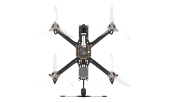
Aluminum frames are getting attention again, and the frame most people point to is the Axisflying Bando 5. Read the spec sheets closely and the story changes. Most listings, including Axisflying's own frame-kit page, describe an aluminum center joined to carbon fiber arms rather than an all-aluminum frame. One Axisflying page disagrees about the arms, which we cover below.
That matters for anyone asking whether to buy aluminum or carbon fiber. If the most visible aluminum frame is really a hybrid, a crash it survives tells you little about aluminum alone. It tells you more about how the parts are shaped and joined. Axisflying's sister frame, the Vertex 5, makes the same point from another direction.
What the Bando 5 is actually made of
A European retailer, Rotorama, lists the Bando 5 arms as 7 mm (about 0.28 in) T700 carbon fiber. On the same listing, the aluminum is 7075 alloy. It serves as the FPV camera mount and as the middle and rear plate. The frame is a True X layout with a 230 mm (about 9 in) motor-to-motor diagonal, takes props up to 5.1 inches, and weighs about 205 g with its plastic parts.
Axisflying's own Bando 5 frame-kit page agrees in substance. It describes an interlocking 7075 aluminum structure combined with thickened T700 carbon fiber. The company homepage sells the idea harder, with the tagline Full aluminum skeleton
and gapless interlocking parts.
Here is the catch. A different Axisflying page, for the complete Bando 5 True X drone, refers to Thick 7075 aluminum arms
. The same page also lists the materials as T700 carbon, 7075 aluminum, and TPU or injection-molded parts. The manufacturer's own pages disagree about what the arms are made of. The retailer specs and the frame-kit page say carbon. Until Axisflying clears it up or someone does a teardown, treat the carbon-arm description as the more consistent one, but do not treat it as settled.
Two frames, two approaches
The Vertex 5 uses the same pair of materials, coated T700 carbon and CNC-machined anodized 7075 aluminum, according to Rotorama's Vertex 5 DC listing. The difference is in the arms.
| Spec | Bando 5 | Vertex 5 DC |
|---|---|---|
| Arm material | T700 carbon (one Axisflying page says aluminum) | T700 carbon |
| Arm thickness | 7 mm | 5 mm, widened |
| Aluminum parts | 7075 center: camera mount, middle and rear plate | CNC-machined anodized 7075 |
| Diagonal | 230 mm | 224 mm |
| Plates | 3 mm top, 2 to 3 mm bottom | 2 mm top and middle, 3 mm bottom |
| Frame weight | About 205 g with plastics | 198 g |
The Vertex 5 arms are thinner than the Bando 5 arms, 5 mm against 7 mm. According to Rotorama's listing, the arms are widened instead, so that the force of a hit spreads out through the frame rather than concentrating at one point. Plate thicknesses above come from Rotorama for the Bando 5 and from French retailer La Caméra Embarquée for the Vertex 5.
Why shape can matter as much as material
An arm breaks where stress concentrates. A thick arm with a weak spot can still fail at that spot. A thinner arm that routes the load into a wider section, and from there into the rest of the frame, gives the energy of a hit more material to pass through. That is the idea behind the Vertex 5 arms as Rotorama describes them.
So the common rule of thumb, that a thicker arm is the tougher arm, is too simple. Thickness is one variable. Width, the path the load takes into the center, and how tightly the arm is held are others. Two frames built from the same carbon and the same aluminum alloy can behave differently in the same crash because of those choices.
The Bando 5 attacks a different part of the problem. A retailer, BZBUAS, says its CNC-machined aluminum center is designed to hold the arms with zero gap. Less play at the joint means the arm and the center move as one piece instead of knocking against each other. That is a design decision about the joint, not a claim about aluminum being stronger than carbon.
7075 is not hardware-store aluminum
When people say aluminum frame, they often picture soft, generic aluminum. Both Axisflying frames use 7075, a high-strength aerospace alloy. It should not be lumped in with softer alloys like 6061 or the flat bar you find at a hardware store.
The familiar shorthand for this debate is that aluminum bends and carbon cracks. We are not going to lean on it here. How each material fails depends on the specific alloy, its temper, and how a carbon part is laid up, and we do not have sourced data to show how 7075 and T700 laminates compare in a crash. For the same reason, this column does not print stiffness, density, or yield-strength figures. If you want those numbers, go to authoritative datasheets, such as the Toray T700S datasheet for the fiber and a materials database for the alloy, rather than forum posts.
Repairability
Repair is where frame design pays off on an ordinary flying day. BZBUAS notes that the Bando 5 arms can be replaced individually. If you clip a gate and break one arm, you swap that arm instead of buying a full frame. Whatever the arms turn out to be made of, that one-arm-at-a-time swap is the repair advantage the retailer points to.
Check this before you buy any frame, hybrid or not. A frame where the arms are part of a single bottom plate means one broken arm retires the whole plate. Separate arms mean a smaller fix. The Frame chapter of FPV Drone Essentials walks through how to read a frame's layout this way, and our FPV Drone Components Explained guide shows where the frame sits among the other parts you will be unbolting during a repair.
North American buyers should also note that Axisflying's store carries a banner saying additional US tariffs apply to all its products. Our column on drone parts tariffs in 2026 covers what that means at checkout.
Weight
On paper the two frames are close. The Bando 5 is about 205 g with plastics and the Vertex 5 DC frame is 198 g. The aluminum center does not make the Bando 5 dramatically heavier than its sibling, but the listed figures also come from retailers and vary slightly between sources.
Built up, these are not light aircraft. Axisflying says the Vertex 5 launched on August 10 as a 460 g drone with a fully enclosed frame and 2406 motors. La Caméra Embarquée lists the ready-built Vertex 5 DC at about 455 g. Either way, that is well above the 250 g threshold. Frame material does not change your FAA registration or Remote ID obligations; weight does. Our Weight and Rules guide explains where your build lands.
By most specs, the Bando 5 is a carbon-and-aluminum hybrid, not a pure aluminum frame. Its sister, the Vertex 5, uses thinner but wider carbon arms to spread impact loads. Judge a frame by its arm shape, its joints and whether arms are replaceable, not by the material name on the box.
How to judge a frame before you buy
- Confirm the arm material across sources. The Bando 5 shows that even a manufacturer's own pages can disagree. Compare the frame-kit listing, the complete-drone listing and at least one retailer.
- Look at arm width, not just thickness. A wider arm that spreads load can be an alternative to a thicker one.
- Check the joint. A tight, zero-gap fit between arm and center reduces play.
- Ask whether arms are replaceable. Individually replaceable arms turn a broken arm into a small repair.
- Know the alloy. 7075 is a high-strength alloy. Do not assume every aluminum part behaves the same.
- Weigh the whole build. The 198 g Vertex 5 DC frame is more than 40 percent of a 455 to 460 g drone, so the frame is a big share of the total, but the finished number is what the rules care about.
Aluminum versus carbon fiber makes a tidy headline, but the frames on the market blur it. The most useful lesson from the Bando 5 and Vertex 5 is that two frames built from the same two materials can take a hit differently because of how they are shaped and joined.
Sources
- Rotorama (retailer) – Axisflying Bando 5
- Axisflying – Bando 5 Frame Kit product page
- Axisflying – BANDO 5 True X FPV Drone page
- BZBUAS (retailer) – Axisflying Bando 5'' Frame Kit
- Rotorama (retailer) – Axisflying VERTEX5 DC O4
- Axisflying blog – VERTEX 5 Launched August 10
- La Caméra Embarquée (retailer) – AxisFlying Vertex 5" DC O4 Wide
- Axisflying homepage
FPV Drone Essentials
668 pages. Components, the full build photographed step by step, Betaflight configuration and flight training.
Buy on Amazon