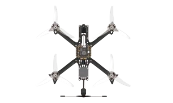
The hobby grew into working equipment. Four fields now depend on it, and each one asks the aircraft for something different.
A camera drone hovers and films. An FPV drone goes where a camera drone cannot — through a gap narrower than its own rotor span, down a stairwell, alongside a moving vehicle at speed. That difference comes from the pilot seeing through the aircraft's own camera in real time rather than watching it from the ground.
It also comes at a cost. FPV aircraft are built rather than bought, tuned rather than configured, and flown with a skill that takes months to acquire. The four fields below accept that cost because nothing else does what they need.
Racing is where the discipline became a sport. Pilots fly a marked course at speeds that leave no room for correction, watching through goggles, with the aircraft often out of direct sight entirely.
The demands are specific and unforgiving. Video latency has to be low enough that what you see matches where the aircraft actually is — a delay of a fraction of a second at racing speed is a crash. Control links have to hold through concrete and bodies. Aircraft have to survive impacts and be repairable between heats.
Racing drives the rest of the field. The low-latency video systems, the long-range control protocols, the durable frame designs — they were refined under race conditions before they reached anyone else.
The one-take shot that follows a skier down a mountain, threads through a window, and pulls out over a valley is an FPV shot. No other platform can hold that line.
Film work inverts the racing priorities. Speed matters less than smoothness; what matters is that the footage is usable. That means carrying a heavier camera than a racing build would, flying deliberately rather than fast, and accepting shorter flight times for image quality.
It also means a different kind of risk. A racing crash costs a frame. A crash on a film set can cost a day of production and injure someone, which is why cinematic FPV work is increasingly done by pilots with formal credentials rather than hobby experience alone.
A building on fire, a collapsed structure, a hillside after a landslide — these are places where sending a person first is the expensive option and sending an aircraft first is the cheap one.
FPV drones fit because they go inside. A camera drone can circle a burning building; an FPV drone can enter it, move down a corridor, and show a commander what is in the room before anyone opens the door. The same applies to structural collapse, where the survivable voids are small and irregular.
What the work demands is reliability over performance. An aircraft that fails in a hazardous space has made the situation worse, not better. Redundancy, conservative power margins and disciplined pre-flight checks matter more here than anywhere else.
Military and law enforcement adoption has moved fastest of all four, for a reason that is uncomfortable but straightforward: an FPV aircraft is cheap relative to what it can observe, and losing one costs nothing compared to losing a person.
The requirements here are range, signal resilience in contested radio environments, and the ability to operate without a permanent ground installation. Much of the hardware is the same as the hobby uses — which is precisely why the field moves so quickly.
Different as they are, every one of these fields depends on the same three things working together: an aircraft the operator built and understands, a video link that shows the truth with no meaningful delay, and a pilot who has flown enough hours to react rather than think.
That is why the path into any of them runs through the same ground — components, assembly, configuration, and practice. There is no shortcut that skips the build.
Where this comes from. FPV Drone Essentials closes with these four fields at pages 641 to 661 — sport and leisure at 641, cinematography at 646, search operations at 651, and defence at 657. They sit at the end of the book for a reason: each one assumes you can already build and fly the aircraft the chapter is describing.
Written by an FAI international judge — components, building, configuration and flight training in one volume.
Buy on Amazon