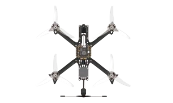
Five things the hobby will ask of you. Knowing them before you spend money is the difference between a flying aircraft and a box of parts.
Consumer drones are appliances. You charge one, press a button, and it holds position while you frame a shot. The manufacturer made every engineering decision before it reached the box.
An FPV drone hands those decisions back to you. That is the point of it — the responsiveness, the ability to fly through gaps, the feeling of being inside the aircraft all come from a machine built for one pilot rather than for everyone. But it means there is real work between buying and flying, and people who skip past that work tend to quit with several hundred dollars of parts that never left the desk.
Here is what the work is.
Ready-to-fly FPV kits exist and have their place, but the actual hobby is a built system: a frame you chose, a stack you soldered, a receiver you bound, firmware you configured. Even people who start with a kit end up rebuilding it, because the first serious crash requires a repair that teaches them the whole machine anyway.
Budget for this from the start. The aircraft is not the only purchase — you will also need a radio transmitter, goggles, batteries, a balance charger, and tools. The transmitter and goggles outlast many aircraft, so they are worth buying once and properly.
Ten parts make the aircraft, and their specifications constrain each other. A frame size determines propeller size. Propeller size determines sensible motor size. Motor KV has to match battery cell count. Motor current draw sets the minimum ESC rating. Receiver protocol has to match your transmitter.
Most expensive first-build mistakes are one of those links broken — parts that each look right on their own product page and cannot work together. This is the single highest-value thing to learn before ordering anything.
The component guide walks through all ten parts in the order those decisions actually run.
Not expertly, but competently. Motor wires to ESC pads, battery leads to the power input, sometimes a video transmitter. Every one of those joints carries current in a machine that vibrates hard, and a cold joint that looks fine on the bench fails in the air.
This is a learnable skill — a few hours of practice on scrap wire is genuinely enough to start. It is also the step people most often try to avoid, and avoiding it limits what you can build and repair for as long as you stay in the hobby.
There are two separate wireless links in an FPV system, and they have nothing to do with each other.
| Link | Connects | Set up by |
|---|---|---|
| Control | Transmitter receiver on the aircraft | Binding, protocol-specific |
| Video | VTX on the aircraft goggles | Matching band and channel |
Beginners routinely conflate the two and then cannot diagnose a failure, because the symptom — "it does not work" — is identical. Learning that they are independent systems is half of learning to troubleshoot them.
Betaflight is the standard configuration software, and it is where a correctly assembled aircraft becomes a flyable one. You verify that the flight controller sees the receiver, that each motor spins in the right direction, that the aircraft's orientation matches reality, and that your flight modes and arming switch behave the way you expect.
None of this is optional. An aircraft that is mechanically perfect and unconfigured will flip on takeoff.
Flying FPV is not flying a camera drone with a different view. There is no position hold, no automatic return, and no altitude assist — the aircraft does exactly what you tell it and nothing else.
The path that works is unglamorous. Start line-of-sight, without goggles, learning the arming switch and hovering until stick inputs stop requiring thought. Then move to a simulator with your own transmitter plugged into a computer, where crashes cost nothing and you can practise the same manoeuvre a hundred times. Only then fly FPV outdoors.
Pilots who skip the simulator stage do not save time. They spend it on repairs instead.
Drone regulation varies by country and changes regularly. In the United States, drone pilots register with the FAA, recreational flyers must pass the TRUST safety test, and commercial operation requires Part 107 certification. Video transmitter power and frequency are separately regulated, and in many jurisdictions 5.8GHz transmission requires an amateur radio licence.
Find out what applies where you fly before you fly, not after.
Where this comes from. Each of the five demands above has its own chapter in FPV Drone Essentials. Components run from page 38 to 256. Tools and the soldering work start at 370, with the software setup at 392. The nine-step build is 403 to 578. Binding and configuration are 500 to 538, with an 80-page Betaflight appendix from 662. Flight training — stick grip, line-of-sight practice, then FPV — is 604 to 640.
Every step above, in full — components, assembly, Betaflight configuration and flight training.
Buy on Amazon