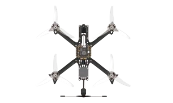
NDAA-Compliant Drones and Blue UAS Explained
US drone sourcing rules now sit in three layers: Pentagon procurement law, the FCC Covered List, and component rules for circuit boards, magnets and batteries. Each layer tests something different, and passing one does not mean passing the others.
"NDAA compliant drone" is used as if it were one certification. It is not. As of October 2026 it covers three separate layers of US rules, written by different bodies, with different tests and different deadlines.
The first layer is Pentagon procurement law: Section 848 of the FY2020 National Defense Authorization Act, Section 817, the American Security Drone Act and the Blue UAS Cleared List. The second is the FCC Covered List, which governs whether equipment can receive a new FCC authorization at all. The third is a set of component rules for printed circuit boards, magnets and batteries, with deadlines in 2027.
The layers matter to two groups in particular: public-safety agencies choosing aircraft, and FPV builders or small manufacturers who want to sell into the US market.
NDAA-compliant and Blue UAS are not the same thing
NDAA compliance is a sourcing condition. It describes where a drone and its parts come from. Blue UAS is a vetted list: the Department of Homeland Security describes it as US- and ally-made drones that are NDAA-compliant and have also been through cybersecurity testing, with Section 848 as the underlying prohibition.
So every Blue-listed aircraft is NDAA-compliant, but an NDAA-compliant aircraft is not automatically on the Blue list. The list eases Pentagon purchasing. It is not mandatory for other government buyers.
One detail is often out of date in buyer guides. The list was long described as vetted by the Defense Innovation Unit, and the DHS report discussed below still says so. FCC documents now refer to it as the Defense Contract Management Agency's Blue UAS Cleared List.
The FCC Covered List: the layer that reaches the civilian market
Procurement law only binds government buyers. The FCC layer is different because it controls equipment authorization, which affects anything sold in the US.
On 22 December 2025 the FCC added all foreign-produced drones and drone critical components to its Covered List, together with the equipment named in Section 1709 of the FY2025 NDAA (Public Notice DA 25-1086). Since that date, new authorizations for those products have been blocked.
The definition of a critical component is broad. The national security determination behind the listing counts batteries, battery management systems and motors alongside flight controllers, radios, navigation systems, cameras and ground stations. That is most of the parts list covered in FPV Drone Components Explained.
The exceptions, and the corrected expiry date
On 7 January 2026 the FCC exempted two groups from the listing: drones and components on the Blue UAS Cleared List, and those that qualify as Buy American domestic end products. Law firm Holland & Knight noted at the time that the exemption ran only to 1 January 2027.
That date has been superseded. On 21 July 2026 the FCC extended the Blue UAS and Buy American exceptions by a year, to 1 January 2028. The Buy American route requires 65% US component value. The FCC also removed the end date for drones holding a Department of War Conditional Approval.
Any guide still quoting January 2027 as the cliff is working from the January alerts.
The new component rule: logic-bearing parts
The newest change is the FCC's Third Report and Order, FCC 26-50, adopted on 22 July 2026. It bars authorization of any device that contains a logic-bearing hardware component made by an entity identified on the Covered List.
Three points define its reach.
- It targets named producers, not countries. The component ban applies only to parts made by entities named on the Covered List. It does not extend to parts from companies caught only by the country-of-production listing for foreign drones. DroneXL reports that for drones the named entities are DJI and Autel.
- It uses a technical test. A component is logic-bearing if it meets the digital-device test of 9,000 pulses per second. The order says a plain battery cell and a bare motor fall outside it, while a battery management system or a motor controller board (the ESC, in FPV terms) likely falls inside.
- It looks forward. The order states
This change is prospective
, and equipment authorized earlier can still be marketed, imported and used.
The rule takes effect 30 days after Federal Register publication. DroneXL reports that publication came on 11 September 2026, which puts the effective date at 13 October 2026. That date is as reported by DroneXL; the order itself gives only the 30-day formula.
Applications already pending on the effective date are exempt. There is a catch: an amendment that adds, substitutes or changes a logic-bearing component after that date is treated as a new application. A manufacturer who swaps a board mid-process loses the exemption.
Two tests that should not be merged
Batteries and motors are critical components under the December 2025 foreign-production listing. A plain cell and a bare motor are not logic-bearing under FCC 26-50. Both statements are true because the two rules ask different questions: one asks where a part was produced, the other asks who made it and whether it contains logic.
It is also unsafe to assume that Blue UAS status shields a product from the component rule. The Blue UAS and Buy American exception was written for the foreign-production listing. Nothing in the fact record reviewed for this column shows it overriding the named-entity component ban, so a seller should check the order before relying on it either way.
| Layer | What it tests | Key date |
|---|---|---|
| NDAA Section 848 and related procurement law | Sourcing of drones bought by the government | In force |
| Blue UAS Cleared List | NDAA compliance plus cybersecurity testing | FCC exception runs to 1 January 2028 |
| FCC Covered List, foreign-production entry | Country of production of drones and critical components | 22 December 2025 |
| FCC 26-50 component rule | Logic-bearing parts from named entities | 13 October 2026, as reported |
| Defense PCB restriction | Circuit boards from China, Russia, Iran or North Korea | 1 January 2027 |
| Defense magnet restriction | NdFeB and SmCo magnets, whole supply chain | 1 January 2027 |
What is still unsettled
The FCC is also seeking comment on whether to ban the import or sale of certain foreign-made "military-grade" drones on the Covered List for non-federal use. The categories under discussion include swarming, thermal-imaging and LiDAR drones, docking stations and aircraft of 55 lb or more. This is a proposal, not a rule.
The legal challenges are open too. According to Iowa State University's Center for Agricultural Law and Taxation, the FCC record on DJI's and Autel's challenges closed in May 2026, DJI's opening brief in the Ninth Circuit is due 2 November 2026, and no track has yet produced a ruling on the merits.
Circuit boards, magnets and batteries
The third layer sits below the finished aircraft and applies to defense purchasing.
Circuit boards. The statutory ban on the Pentagon acquiring covered printed circuit boards from China, Russia, Iran or North Korea takes effect on 1 January 2027. Crowell & Moring reported in July 2026 that the implementing regulation was still at advance-notice stage, with an exception planned for commercial and off-the-shelf items. The scope of that exception is not final.
Magnets. Also from 1 January 2027, DFARS 252.225-7052 widens the defense magnet restriction to the whole supply chain, according to supplier Arnold Magnetic Technologies. Neodymium and samarium-cobalt magnets are barred if any step from mining through to final production took place in China, Russia, Iran or North Korea. Every brushless motor on a drone depends on such magnets, which is why this rule reaches small aircraft.
Supply. These rules assume a domestic supply that is still being built, and Washington is paying for it. Defense Daily reported on 23 September 2026 that the Army selected Vulcan Elements to supply magnets for SkyFoundry small-drone motor production tied to Tobyhanna Army Depot. Army Technology reported that Amprius received a Department of War grant of up to $75 million to convert a US electric-vehicle battery line to drone cells, with planned output of 12 million cells a year by early 2028 and a total cost of about $100 million. DroneXL reports that only $22 million of the grant is funded so far, with the rest dependent on future appropriations.
What this means for public-safety agencies
A compliant aircraft is not necessarily a capable one. In September 2026 DHS's National Urban Security Technology Laboratory published a comparative assessment of six Blue UAS models, flown by 26 remote pilots in College Station, Texas (June 2024), Miami (November 2024) and New York City (July 2025).
In the New York round only two aircraft received overall scores: the Skydio X10D at 3.7 out of 5 and the Parrot ANAFI USA GOV at 2.4. The Ascent Spirit, Freefly Astro and Teal 2 were judged unsafe to fly in that environment because they drifted when asked to hold position. Evaluators also saw control-link disconnects as close as 50 feet from launch.
DHS says plainly that the Blue designation does not establish whether a drone can do the jobs public safety needs. The assessment looked at operator experience only and did not evaluate national security risk.
Cost is the other finding. As-tested prices ranged from $13,964 for the Parrot to $56,195 for the Ascent Spirit, and DHS names cost as a barrier for many departments. Drones from covered nations were flown alongside in New York; those results are not in the public report, but DHS provides them to public-safety agencies on request.
Compliance answers the question of where a drone comes from. It does not answer whether it holds position between tall buildings. Agencies need both answers before buying.
What this means for FPV builders who sell into the US
For a builder, the practical unit is no longer the finished quad but each board inside it. The Battery and Motors chapters of FPV Drone Essentials treat a cell and a motor as simple parts, and the FCC component rule agrees: neither is logic-bearing. The boards that manage and drive them are a different matter, which makes the power chain the place to start a sourcing audit.
Three checks follow from the rules above.
- For each board with logic on it, identify the producer, not just the country. The October component rule turns on named entities.
- If a product relies on the Blue UAS or Buy American exception, plan around 1 January 2028, and track the 65% US component value threshold.
- If an authorization application is pending, avoid changing logic-bearing components after the effective date, since that restarts the application.
Equipment authorized before the rule took effect is unaffected. Hobbyists flying existing gear still answer to the FAA rules summarized in Weight and Rules, not to procurement law.
For the personnel side of the same shift, see Military FPV Drone Pilot Training: What Transfers.
Sources
- FCC Public Notice DA 25-1086
- Holland & Knight alert (summarising FCC DA 26-22)
- FCC Fact Sheet: FCC Takes Action to Secure the Drone Supply Chain
- FCC Third Report and Order FCC 26-50
- DroneXL
- Iowa State University Center for Agricultural Law and Taxation
- DHS S&T NUSTL, Blue UAS for First Responders Comparative Assessment Report (SAVER-T-R-39)
- Crowell & Moring client alert
- Arnold Magnetic Technologies
- Defense Daily
- Army Technology
FPV Drone Essentials
668 pages. Components, the full build photographed step by step, Betaflight configuration and flight training.
Buy on Amazon