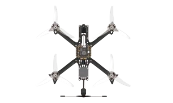
A drone you buy has its weight printed on the box. A drone you build does not. You work it out yourself — and that number is the one the regulator asks about.
This page describes United States rules as of 2026 and is general information, not legal advice. Requirements differ by country and change. Check what applies where you fly, with the authority that governs it, before you fly.
Most drone regulation starts from a weight threshold. Below it, one set of obligations. At or above, another. That structure is close to universal — the numbers differ by country, the shape does not.
Which creates a problem specific to this hobby. A built aircraft has no manufacturer's figure. It is the sum of the parts you chose, and it changes every time you swap a battery or bolt on a camera. The person responsible for knowing which side of the line you are on is you.
The threshold in the United States is 250 grams (0.55 lb) at takeoff, and "at takeoff" is doing real work in that sentence. It means the aircraft as it leaves the ground: airframe, battery installed, and anything you are carrying.
At or above that weight, you register with the FAA. Below it, recreational flyers do not have to — but the exemption is narrower than people assume.
| Build | Typically |
|---|---|
| 5-inch freestyle or racing quad | Comfortably over 250g. Register |
| 3-inch build with an action camera | Usually over. Weigh it |
| Tiny whoop, bare | Usually under |
| Anything flown commercially | Register regardless of weight |
The middle row is where builders get caught. A sub-250g airframe plus a heavier battery plus a camera can cross the line without any single decision feeling significant. Weigh the aircraft as you fly it, on a scale, rather than adding up spec sheets.
Registration is not a standalone form. Being registered — or being required to register — brings Remote ID into scope, which means the aircraft has to broadcast identification during flight, either through built-in capability or a broadcast module.
For a builder this is another component decision, and one that is easy to leave until after the build is finished. It is worth deciding before, because it affects mounting space and weight, which affects the threshold you were just calculating.
Recreational flyers in the US must pass TRUST, The Recreational UAS Safety Test. It is free, taken online, and you keep proof of completion to show on request.
It is not an exam in any demanding sense. It exists so that people flying for fun have encountered the rules once, deliberately, rather than absorbed them from forum posts.
If the flight is for business — paid work, footage you will sell, anything furthering a commercial interest — you need a Part 107 Remote Pilot Certificate. That is a real test at a testing centre, and it carries obligations that recreational flying does not.
The boundary catches people out. Posting monetised footage of your own flying can put you on the commercial side of a line you did not know you were near.
Here is the part general drone guides skip, because it only applies to this way of flying.
Recreational operation requires keeping the aircraft within visual line of sight — you have to be able to see it, so you can see and avoid other aircraft. Goggles are not visual line of sight. Wearing them, you see what the camera sees and nothing else.
The accepted answer is a visual observer: a second person standing beside you, watching the aircraft with their own eyes, in direct communication with you throughout the flight. Not a camera. Not a spotter who wanders off. A person whose job for that flight is to maintain the line of sight you gave up when you put the goggles on.
This is the single most common gap between how FPV is actually flown and how it is supposed to be flown. It is also the requirement most likely to matter if something goes wrong.
Airspace is the other axis, and it is independent of weight. Controlled airspace near airports requires authorisation. National parks, many stadiums during events, and various restricted areas are closed regardless of registration status.
Check before each flight at a new location rather than relying on memory. Airspace changes, and temporary restrictions appear around events with no notice you will happen to see.
If you fly outside the US, the numbers change but the questions do not. Every system I have worked with asks the same four:
Learn to answer those four for your own build and you can answer them again in another country by looking up four numbers rather than starting over.
Where this comes from. FPV Drone Essentials covers pre-flight regulation at pages 580 to 602 — general drone rules at 580, pilot certification at 582, and flight zone restrictions at 590. That treatment is written to Korean regulation, so the specific thresholds differ from the US figures above; what carries across is the method — how to establish your own takeoff weight from a parts list, and why an FPV flight is treated differently from a line-of-sight one. Battery weight, which is usually the deciding component, is covered in the battery section at 158.
744 pages, written by an FAI international judge. Components, build, configuration and flight training.
Buy on Amazon