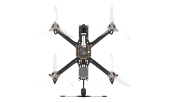
How to Build a 1S 3-Inch Toothpick Under 50 Grams
Moving a BetaFPV whoop's all-in-one board, camera and canopy onto a Crux3 frame gives a 3-inch toothpick that weighs 49 g with a 480mAh pack. Here are the parts, the Betaflight settings, and the firmware gaps to check before you bind.
Oscar Liang published a 1S 3-inch analog toothpick on September 27, 2026 that weighs 36.3 g dry and 49 g with a 480mAh pack. The approach is reuse: the flight controller, camera and canopy come off a BetaFPV tiny whoop and move onto a Crux3 frame, joined by Happymodel EX1202.5 11500KV motors and Gemfan 3018 two-blade props. The builder reports more than five minutes of flight time, and the conversion needs no soldering.
Below are the parts, the reason behind each choice, the few Betaflight changes the build uses, and the places where the board's shipped firmware now lags current releases. One of those gaps can keep the quad from binding to your radio.
The donor whoop
The original build takes its electronics from an Air65 or Air75. Both the Air65 II and the Air75 II carry the same Matrix 1S 5IN1 II board and C03 camera, so either works as a donor. The parts list names the Air65 II canopy.
According to BetaFPV's spec sheet, that one board holds an ESC rated at 12A continuous and 18A peak running Bluejay, a serial 2.4GHz ExpressLRS receiver on version 3.4.3, a 5.8GHz VTX that reaches 400mW, and Betaflight 4.5.3 on the BETAFPVG473_V2 target. With the whole flight stack on one board and the camera and canopy coming along as a set, there is nothing to solder.
Parts list
| Part | What the build uses | Notes |
|---|---|---|
| Frame | Crux3 | Retailer listings put it near 7 g with a 115 mm wheelbase; not confirmed with the manufacturer |
| Flight controller | BetaFPV Matrix 1S 5IN1 II | From an Air65 II or Air75 II |
| Camera and canopy | C03 camera, Air65 II canopy | From the same whoop |
| Motors | Happymodel EX1202.5 11500KV, four | 4.4 g each, rated for 1S only |
| Props | Gemfan 3018 two-blade | About 3.32 g per set of four |
| Battery | BetaFPV LAVA II 1S 480mAh | 12.6 g, BT2.0 connector |
| Screws | M2x10 | 10 mm long |
The frame, motors and props were bought together as a single AliExpress kit, though each is also sold on its own. Be aware that the AliExpress Crux3 may not be identical to Happymodel's original frame.
One correction: the original parts list says "M2 10cm" screws. That is a typo. The build steps specify M2x10, which means 10 mm long.
Motors: match the KV to one cell
The EX1202.5 has a 12 x 2.5 mm stator wound 9N12P, a 1.5 mm shaft, and a weight of 4.4 g. It is also the motor the Crux3 comes with stock.
The number that matters most is the KV. The 11500KV version is rated for a single cell only. The same motor also comes in 6400KV and 8000KV, and retailer listings indicate those are meant for 2S to 3S. On a 1S toothpick you want the 11500KV winding, and a lower-KV version is the wrong pairing for one cell.
That makes KV the first thing to verify when the kit arrives. Listings are not always careful either; Pyrodrone's own listing prints the rating as "KV115000". If your motors are not marked 11500KV, they are not the motors this build is designed around.
For the reasoning behind pairing KV with cell count and prop size, see KV, Cells and Propellers, or the Motors chapter of FPV Drone Essentials.
One question stays open. BetaFPV lists 0702, 0802 and 1102 motors as what the Matrix board is meant to drive. Neither BetaFPV nor Happymodel publishes current-draw or thermal figures for the EX1202.5 11500KV spinning 3018 props on this 12A ESC, so the safety margin is unverified. Treat the first few packs as tests: keep them short and check the board and motors for heat when you land.
Props: light two-blades
The Gemfan 3018 is a 3-inch, 1.8-inch-pitch two-blade prop molded in polycarbonate. Progressive RC lists a set of four at 3.32 g, roughly 0.83 g apiece; other listings range from about 0.75 to 0.85 g per prop.
Add up the propulsion and you find most of the weight. Four motors at 4.4 g come to 17.6 g, and the props add about 3.3 g, so roughly 21 g of the 36.3 g dry weight is motors and props. That is the largest share of the dry weight, and the first place a heavier substitute will show up on the scale.
Battery: where the 50 g line sits
BetaFPV's LAVA II 1S packs are LiHV cells that charge to 4.35V, carry a 95C rating, and use the BT2.0 connector. The weight step between capacities decides whether the finished quad stays under 50 g.
| Pack | Pack weight | All-up weight |
|---|---|---|
| 280mAh | 6.8 g | about 43.1 g |
| 320mAh | 8.2 g | about 44.5 g |
| 480mAh | 12.6 g | about 48.9 g (49 g as built) |
| 580mAh | 14.1 g | about 50.4 g |
| 680mAh | 16.2 g | about 52.5 g |
The all-up figures are the 36.3 g dry weight plus BetaFPV's listed pack weight. The under-50 g claim holds only at 480mAh or smaller. The 580mAh and 680mAh packs tip it just over, though every option stays far below 250 g.
The flight time, more than five minutes on the 480mAh pack, comes from a single build with no flying style or VTX power stated. Nobody has independently tested the weights or the endurance, so expect your numbers to differ.
Betaflight settings
The builder leaves the board on its stock Betaflight 4.5.3, reasoning that the stock firmware is fine
, and reports that the default PIDs and filters work well. Only a few settings change:
- Power & Battery: minimum cell voltage 3.2V, warning cell voltage 3.4V.
- DShot beacon: turn on both beacon options.
- Motor Poles: 12, which matches the 12P in the motors' 9N12P configuration.
- Motor direction is reversed: optional. Enable it if you prefer to fly props-out.
What has changed since the board shipped
ExpressLRS: check before you bind
This is the gap most likely to stop you at the field. The receiver ships on ELRS 3.4.3, and ExpressLRS 4.x cannot link with 3.x. The radio module and the receiver have to run the same major version. The current release is 4.1.0 from July 17, 2026, and the last 3.x release was 3.6.4 from June 8, 2026.
If your module already runs 4.x, you have two options: flash the Matrix receiver to 4.x, or keep the module on 3.x. Leave them mismatched and the quad will not bind.
Betaflight: the gyro warning looks stale
Betaflight has moved to year-and-month version numbers, 2025.12 and then 2026.6, and the current stable release is 2026.6.2 from September 16, 2026. That leaves the board's 4.5.3 three version lines behind.
BetaFPV's Matrix II and Air65 II pages still tell owners not to flash official Betaflight because some boards use ICM42622 or LSM6DSK320X gyros. The Betaflight 2026.6 release notes now list official support for the ICM-42622P and LSM6DSK320X, so that warning appears out of date.
Do not reflash on that alone. Depending on the batch, a Matrix II board can carry any of four gyros: ICM42688P, ICM42622, BMI270 or LSM6DSK320X. Check in Betaflight which one yours has and confirm the board target is supported before flashing. If the stock firmware flies well, there is no urgent reason to move. When you do, How to Update Betaflight Firmware Without Losing Your Tune walks through the process.
Bluejay
The ESC ships with Bluejay 0.19. The latest stable release is Bluejay v0.21.0 from July 19, 2024, and Bluejay supports bidirectional DShot RPM telemetry. The build as published runs the stock firmware.
Rules for a 49 g quad
Staying under 250 g removes some paperwork, not all of it. The threshold is measured at takeoff with the battery installed, and every pack in the table above clears it by a wide margin.
United States
- Registration: under the FAA's recreational rules, you register only at 250 g (0.55 lb) or more, so this build does not need it.
- Remote ID: Remote ID covers drones that must be registered or already are. An unregistered sub-250 g recreational quad is exempt. Register it voluntarily and Remote ID applies.
- TRUST: every recreational pilot must pass the free TRUST test and carry proof, whatever the drone weighs.
- Line of sight: keep the quad in visual line of sight, or fly with a visual observer standing next to you. Flying on goggles alone means bringing a spotter.
- Airspace: airspace rules still apply at any weight.
- Radio: the AMA notes that few FPV video systems hold Part 15 certification for unlicensed use. Flying an analog VTX like the Matrix's generally takes at least a Technician-class amateur license under Part 97. Certification depends on the VTX's FCC ID, and most analog units have none. BetaFPV recommends 25 to 100mW indoors.
Canada
Transport Canada calls drones under 250 g microdrones and requires neither registration nor a pilot certificate for them. Since April 1, 2025, flying one at an advertised event still requires an SFOC.
For more on how weight interacts with these thresholds, see Weight and Rules. The Rules chapter of FPV Drone Essentials covers the same ground for US flyers.
This toothpick stays under 50 g only with a 480mAh or smaller pack, and its ELRS 3.4.3 receiver will not bind to a 4.x radio module until one side is flashed to match.
Sources
- Oscar Liang
- Pyrodrone (retailer listing)
- Progressive RC (retailer listing)
- BetaFPV
- BetaFPV
- Betaflight 2026.6 Release Notes
- ExpressLRS GitHub release 4.0.0
- FAA – Recreational Flyers & Community-Based Organizations
- FAA – Remote Identification of Drones
- Transport Canada – Microdrones
- Academy of Model Aeronautics – FCC Requirements for Model Aircraft Operations (Doc 590)
FPV Drone Essentials
668 pages. Components, the full build photographed step by step, Betaflight configuration and flight training.
Buy on Amazon